By law, men and women must receive equal pay for the same, or broadly similar, work; work rated as equivalent under a job evaluation scheme or work of equal value.
We have a clear policy of paying our colleagues equally for the same or equivalent work.
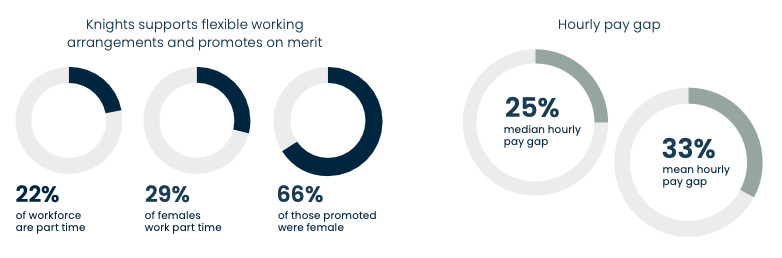
Our median gender pay gap has reduced from 32% to 25% since our 2024 report. Our mean gender pay gap has also reduced from 36% to 33% since the 2024 report, and both have steadily reduced since we began reporting in 2017. In line with statistical commentary, we consider that our median figures are more statistically representative of our Gender Pay Gap than our mean figures.
Since our first report in 2017, we have seen a significant reduction (20%) in our median gender pay gap which has reduced from 45% to 25% this year. We are actively committed to ensuring that our colleagues are paid fairly for the work that they do and this change reflects that commitment. We are confident that our gender pay gap reflects the types of roles within our business that are predominantly undertaken by females alongside historic barriers to access to the legal profession for women. The practical impact of this is that there are fewer highly experienced female lawyers than male in the sector generally and that is reflected in our business.
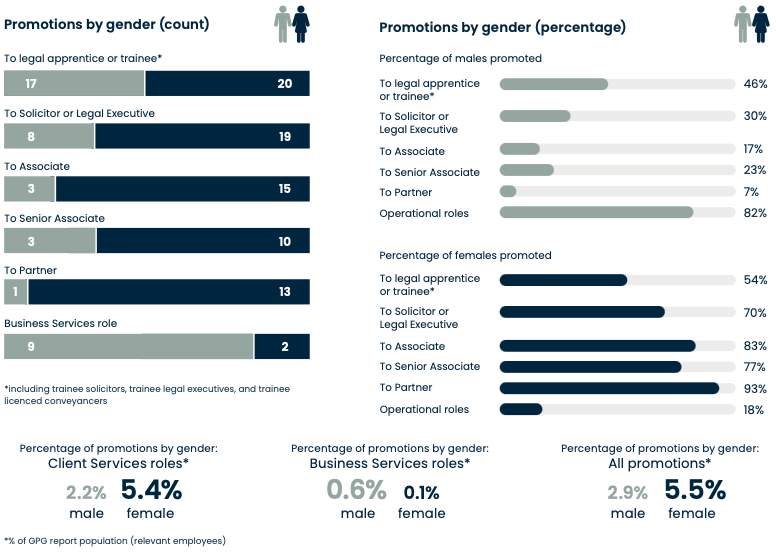
We are proud of our commitment to fairness and equality to all of our colleagues and we are continuing to make significant progress in eroding historical gender pay gaps as shown by our promotions during the reporting period of which 66% were female and, of those promoted to Partner or Senior Associate, 85% were female. We continue to promote on merit alone rather than tenure or other factors which has resulted in a greater proportion of promotions for female colleagues as compared to male across the board.
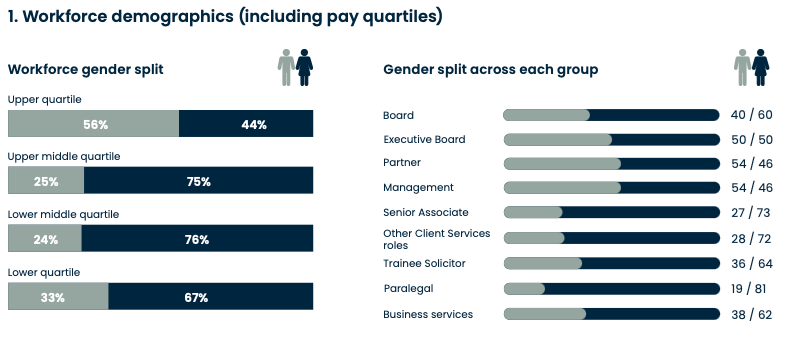
We have continued to complete a more detailed analysis of the pay gap by reference to job group and found that our pay gap is most significant within our Partner group. Of those Partners with a professional qualification (noting that we employ non-legal professionals alongside our lawyers) post-qualification experience (PQE) ranges significantly, from 0 to 45 years.
As a result of the overall historical barriers to females entering the profession generally, the gap within this group is entirely expected, with some recently promoted to Partner, and others having been in the position for a decade or more.
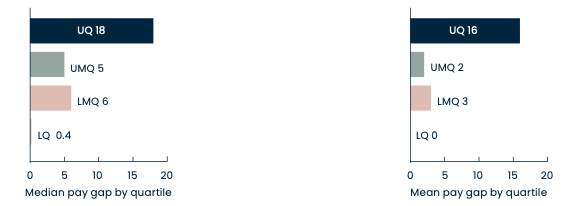
We also reviewed the quartile into which our Partners fell for their hourly pay, comparing this with their number of years PQE and associated hourly charge out rate. The comparison showed a direct correlation between an individual’s experience, charge out rate, and hourly pay.
As expected, based on the demographics of the legal profession as a whole, we have a greater proportion of male colleagues with more PQE within this group and, although there are exceptions to this, it is reasonable to expect that those with more experience will, generally speaking, have a higher hourly rate of pay. While this data is assuring, we are not complacent, and we will continue to analyse our pay data by reference to job group as a check that decisions around remuneration continue to be made fairly and without any reference to gender.
We also remain committed to being a family friendly employer, matching the pay available for those on maternity leave and shared parental leave, and accommodating a wide variety of flexible working arrangements, with 22% of our workforce working part time in the reporting period (up from 20% last year).
While it remains the case that a greater proportion of women in our business work part time, we seek to ensure that, when pro-rated, pay is the same as those working full time.